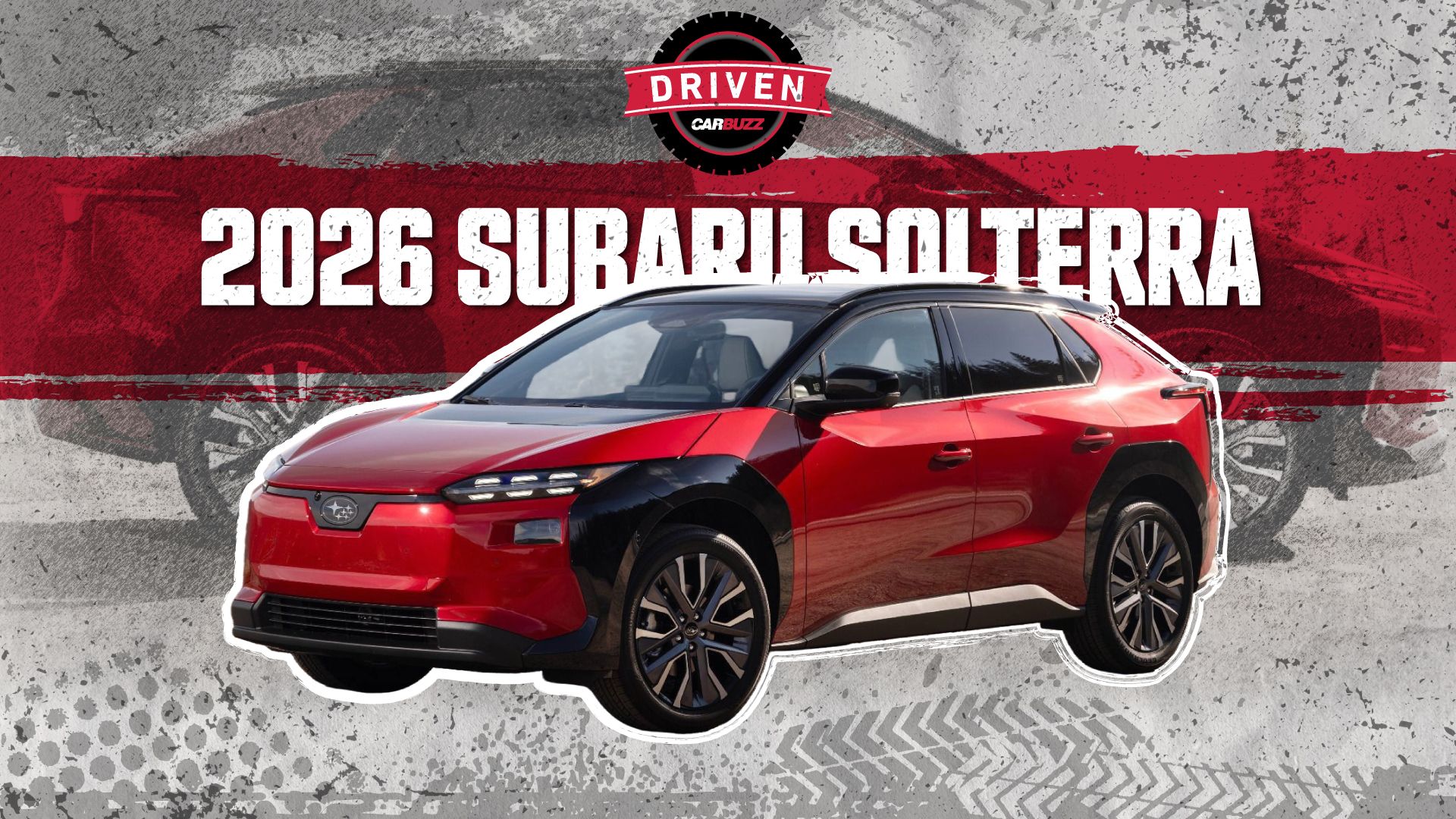
This Is What It Should’ve Been From The Start
Subaru and Toyota now have more than a decade of developing cars together. Their first efforts with the rear-wheel-drive BRZ and its Scion- and Toyota-badged twins were nearly instant hits that spawned similarly well-received successors. So, it’s not entirely surprising that the companies have worked more closely together for other products, such as their first EVs for the North American market, the Solterra and bZ4X. When they hit the market for the 2023 model year, though, the reception was lukewarm at best. They lacked the power, range, and charging speed of their rivals, all without any price advantage and somewhat odd styling. The Toyota also had a weird name.
- Base Trim Engine
-
Dual-Motor EV
- Base Trim Transmission
-
Single Speed
- Base Trim Drivetrain
-
All-Wheel Drive
- Base Trim Horsepower
-
233 hp
- Base Trim Torque
-
250 lb-ft
- Body-colored fender option looks good – and we like the headlight detail
- Spacious interior with supportive seats
- Great visibility
- Light and playful chassis with punchy powertrain in XT
- Still too similar in looks to Toyota sibling
- Interior plastics feel a little low-end
- Throttle response is a little lethargic
Ever since, the joint development teams consisting of personnel from both companies have been working to get the EVs into fighting shape. Price cuts and charging improvements certainly helped, but even up to the 2025 model versions, it’s been hard for us to find a reason for someone to buy a Solterra or bZ4X over their seriously impressive competition. Now, though, having driven the thoroughly revised 2026 Subaru Solterra, we think it’s finally time you put the EV on your short list.
First Drive events provide our initial impressions of a vehicle in a restricted environment under certain time constraints. Keep an eye on CarBuzz for our comprehensive Test Drive review which will follow soon.
What’s Changed For This Model Year?
Despite similar looks to the previous model, the new Solterra has been majorly overhauled. It has new motors that produce more power and are more efficient. The battery pack has a larger capacity, and it should have better charging performance. The chassis has redesigned subframes and retuned suspension, too, and Subaru says that it and Toyota changed so much that this Solterra is considered to be on a new platform.
Exterior Looks: Is This Really The New One?
|
Strengths |
Weaknesses |
|---|---|
|
|
|
For as much as the Solterra has changed mechanically, the design looks nearly the same as before. The most noticeable changes are to the front fascia. Subaru ditched the distinct faux grille surround for a rather featureless nose. This also makes it a little tougher to distinguish the Solterra from the also modestly detailed bZ (now without its 4X suffix). New headlights accompany the new fascia, and Subaru apparently made sure to have six small elements on each lamp as a nod to the stars on the Subaru badge. It’s a nice touch, though it’s also subtle enough few people will probably think much of it.
Like the Toyota, the Subaru is now available with body-matching painted fenders, or black-painted contrasting ones. The matched ones are only available with white, black, and a dark silver, though. The new options offer a nice alternative look, though we actually do miss the option of unpainted fenders, which seemed very fitting for a Subaru. We’re not sure we’d call the Solterra particularly great looking, but it’s also far from terrible. With such small exterior changes, too, your opinion, just like ours, probably won’t change much from the last model.
Interior: Function Over Form
|
Strengths |
Weaknesses |
|---|---|
|
|
|
Subaru and Toyota did make quite a few changes inside. The dash is more squared off, losing the upholstered top panels and the funky plastic extensions from the instrument cluster to the steering wheel. It’s a move that definitely takes away some of the uniqueness we liked about the outgoing model. However, the companies also banished the dust- and fingerprint-attracting piano-black trim, which we will always applaud. The infotainment screen has been enlarged to 14 inches from the previous 12.3. That bigger screen comes with a pair of physical knobs for controlling climate functions, a welcome improvement the touch-button-only solution of the old model. Below the controls is now a wide tray that contains standard dual wireless charging pads. While it may not be as funky as before, the Solterra’s new interior is definitely more user-friendly.
We do wish Subaru and Toyota had upgraded some of the interior materials, though. Many of the plastics, even those that feel a bit padded, have a somewhat rough texture, almost like a neoprene. The plastics don’t really improve on higher trims, either, so even the Limited and Touring models end up feeling a little cheap. Subaru makes up for this a bit with attractive color schemes. The black and gray options that are pretty commonplace look handsome, but the available blue selection really pops.
While the materials could use a little improvement, interior comfort isn’t a problem. Head- and legroom are generous up front and in the rear. Cargo space is unchanged at 23.8 cubic feet behind the rear seats and 63.5 with them folded. The front seats are impressively supportive with plenty of cushioning and lumbar support. The bolsters won’t hug you, but are enough to keep you steady in corners. The driver’s seat has eight-way power adjustment, and both front seats have heating as standard. Upgrading to the Limited trim adds power adjustment to the passenger side, and the Touring model adds ventilation.
Infotainment: The Same, But Bigger
While the infotainment screen is bigger, the system remains the same, which is what you’ll find in other current Toyota models. It’s straightforward, with just a few main shortcut tabs on the driver side, and your selected function filling the screen, and there’s not really a home screen to go to. Everything is clear and easy to read, and there’s no lag when tapping away at buttons. As we mentioned, the knobs are a big help for adjusting temperature quickly and conveniently, and the same goes for the little volume knob in the middle. The instruments still appear in a smaller screen at the base of the windshield. It looks strange, but it works well, basically sitting where a head-up display would be. The graphics it displays, though, look a bit dated, as though they could’ve appeared on a Toyota from at least five years ago.
Powertrain & Driving: Surprisingly Fun
|
Strengths |
Weaknesses |
|---|---|
|
|
|
We were able to drive the Solterra in and around Denver, and our route took us on highways, twisty mountain roads, dirt paths, and even some light off-roading. We also got to spend time in models with each powertrain, and that’s as good a place to start as any with the new EV. For 2026, Subaru and Toyota have switched to newer, lighter motors that now have their silicon-carbide inverters included in the motor casing. The motors and transmission also feature improvements to efficiency as well as size and weight, such as thinner lubricants and even polished gear teeth. Power is up, too. The base motors now make a combined 233 horsepower – 18 more than before. Even more exciting is the powertrain for the XT models, which adds an even more powerful rear motor to bring total output to 338 horsepower. As for torque, Subaru hasn’t given official combined numbers. The base powertrain should have around 250 pound-feet of torque, and the XT powertrain should have about 323, but that still needs to be confirmed by Subaru.
Subaru says this one will hit 60 mph in just 4.9 seconds, and that seems believable. Once you get through the somewhat slow-responding throttle pedal (yes, even in the sportiest drive mode), the Solterra XT feels every bit as punchy as its competition, perhaps more so thanks to its relatively low curb weight (more on that soon). You definitely notice the XT’s power advantage the deeper you push the throttle, and it feels strong all the way through interstate speeds. The base model powertrain feels more than adequate, but acceleration tapers off more dramatically with how much throttle you use and as the speeds increase. Still, the base model never feels slow, and if you don’t care about not roaring past the occasional GTI at a stop light, it’s a solid option.
2026 Subaru Solterra Powertrain Options
|
||
|
Base |
XT |
|
|---|---|---|
|
Engine |
Dual-motor |
Dual-motor |
|
Transmission |
Single-speed |
|
|
Drivetrain |
AWD |
|
|
Power |
233 hp |
338 hp |
|
Torque |
~250 lb-ft |
~323 lb-ft |
Subaru and Toyota also spent time improving the other half of the powertrain: the battery pack. Capacity has risen slightly from 72.8 kWh to 74.7 kWh. Combined with many other efficiency boosters such as those we already talked about in the powertrain, as well as redesigned underbody panels and even lower-drag wheel bearings, range has shot up for the Solterra. Instead of 227 miles, the base Solterra can go 288 miles. The higher-output XT doesn’t lose much range, either, coming in at 278 miles, the same as the Limited model with the lower-output powertrain. The main culprit in the range reduction seems to be the switch from 18-inch wheels to 20-inch examples on the Limited and Touring trims. The efficiency gains of this new model are arguably more impressive than the raw range, though. The base Premium trim gets 131 mpg-e in the city, 109 on the highway, and 120 in combined driving. The Limited trims and higher get 128 mpg-e in town, 105 on the highway, and 117 combined. The most efficient 2025 Solterra only got 104 mpg-e in combined driving.
Not only will you have to charge less frequently in a new Solterra, but you’ll be able to charge more quickly, too. AC charging speeds now reach 11-kW, rather than 6.6 previously. DC charging, meanwhile, has gone up from 100 kW to 150. Subaru estimates a charge from 10% to 80% will take about 30 minutes, shaving 5 off the old fast-charging time. Credit goes to the upgraded on-board charger and improved battery heating and cooling system.

Moving away from the powertrain, and the news continues to be good in the ride and handling departments, too. As mentioned, the front subframe has been redesigned, along with many of the suspension components. The mounts for those, the motors, and the radiator have been stiffened, and the roof has been reinforced. The front springs and shocks have been stiffened and the rears softened. Not only that, but the Solterra remains relatively light for an EV. The base model is only 30 pounds heavier than before, with a total of 4,395 pounds, and at the other end of the range the Touring XT weights 4,510 pounds, just 5 more than the top-spec of the previous generation. For reference, those weights match up with the front-drive Nissan Ariya line and the long-range rear-drive Hyundai Ioniq 5, while being a couple hundred pounds less than those models’ all-wheel-drive variants, and others such as the Ford Mustang Mach-E.
This all helps the Solterra become a surprisingly fun on-road companion. Steering feels quick and somewhat hefty, with the little steering wheel feeling rather sporty. You can even feel a fair bit of the road. On top of all that, the car feels as light as it is, changing direction confidently and easily, despite a decent bit of body roll. That body roll does hint at a fair bit of give in the suspension, which means that the Solterra soaks up bumps nicely, and it helps the car feel stable on Colorado’s undulating mountain roads. If you do get frisky behind the wheel, though, the Solterra does reign things in fairly quickly with a smooth but overly cautious traction and stability control system. That’s perfectly reasonable considering the fact that neither Subaru nor Toyota are marketing this vehicle as actually sporty. We just hope that maybe some of the Solterra’s cousins, such as the Uncharted, might have a slightly less intrusive system to cater to enthusiast drivers. Maybe Subaru could even roll out some kind of WRX version of these cars. The chassis certainly feels great as it is; a few tweaks, and you could have something quite compelling.
Subaru also let us experience some of the Solterra’s off-pavement capabilities with a short forest obstacle course. With the same 8.3 inches of ground clearance as before, it has 0.4 inch less clearance than an Outback. Still, it’s enough to get down even relatively rough access trails to reach campsites or hiking paths. Supplementing the ground clearance are a few electronic aids. Subaru includes its X-Mode drive modes for low-traction surfaces, hill descent control, and a low-speed off-road cruise control system called Grip Control. The latter seems to be most useful for more challenging obstacles, such as the offset dirt mounts we drove over.
The Solterra seemed to struggle a bit moving forward over them when under manual throttle control, but setting the Grip Control allowed it to creep over at its own happy pace with far less difficulty. Having these aids is also helpful considering the fact that the Solterra’s fully independent suspension doesn’t allow for much articulation, lifting wheels on obstacles like those mounds and requiring the traction control system to get power to the wheels on the ground. Since we’ve already proposed a WRX-style vehicle on this platform, we think Subaru ought to also prioritize getting a Wilderness version of this or possibly the upcoming Trailseeker on the market with more ground clearance and capability.
Verdict & Pricing: An Excellent EV As Long As It Doesn’t Get Too Expensive
The only thing we weren’t able to learn while driving the Solterra is how much it will cost. Subaru hadn’t finalized pricing, and still hasn’t at the time of publishing. We should know in a few more weeks, though, especially since production will start in September. The new models will start hitting dealers around November. We wouldn’t be surprised if the base Premium trim’s price rose a little bit, as tends to happen with new models, but hopefully not much more than that, especially considering things like battery capacity haven’t changed dramatically. Pricing for its Toyota twin seems to support only modest price increases. For reference, the outgoing Solterra has a base MSRP of $38,495. With the $1,420 destination charge, that becomes $39,915. We do expect a larger price premium going from Limited trim to Limited XT, since the XT version has the more powerful rear motor. Naturally, the top-spec Touring XT will be the most expensive.

Assuming that pricing doesn’t change too much from the current Solterra, Subaru has a real winner on its hands. All of the problems have finally been sorted out, and the things that were decent to start with, such as the driving dynamics, are even better than before. We wouldn’t say it’s the best in its field, since there are options with more impressive charging and design. However, you won’t just be shopping for a Solterra because you want an EV with a Subaru badge anymore, you’ll be shopping for one because it’s a good EV, period.