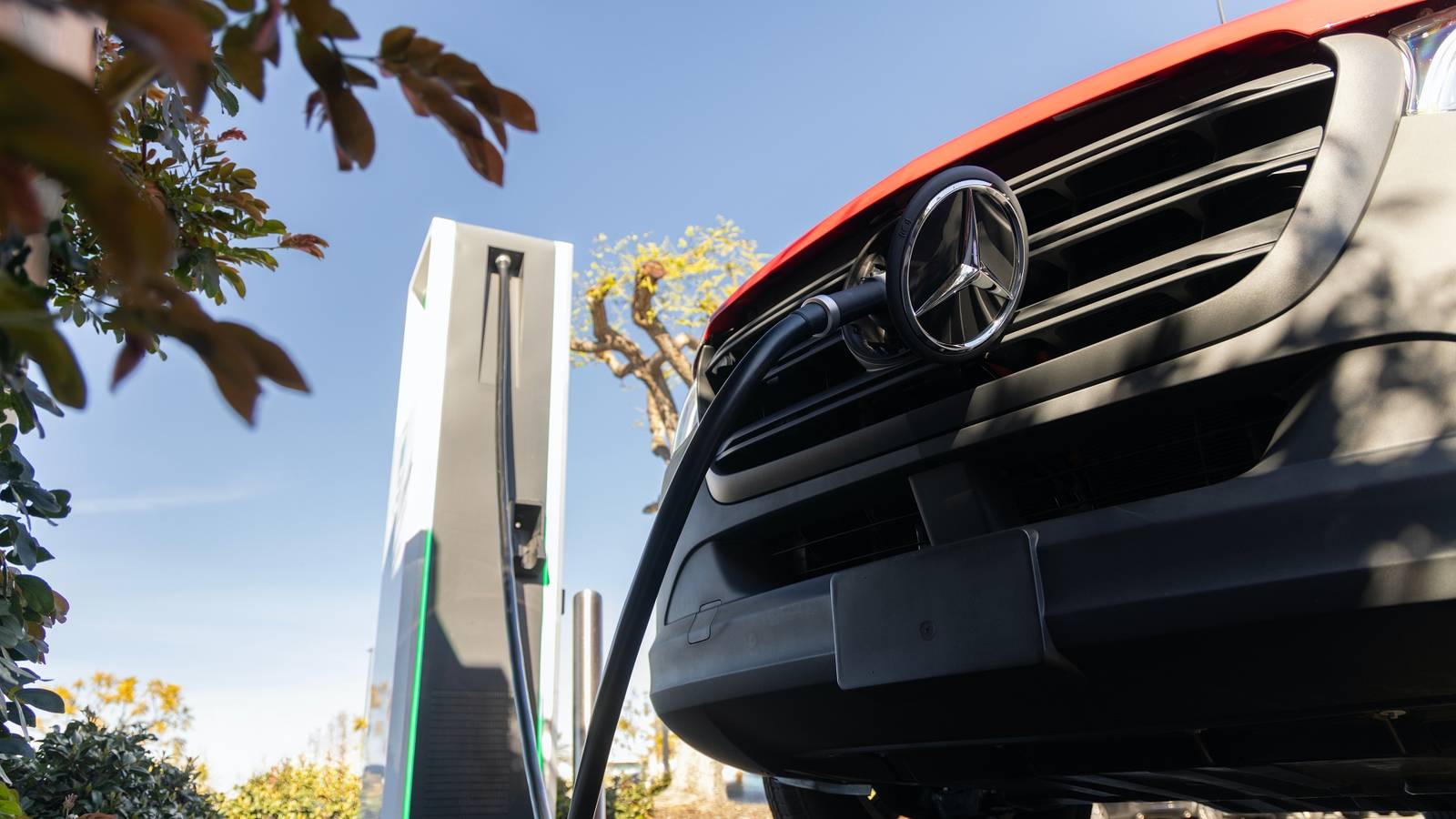
Mercedes-Benz’s 10-Minute EV Charging: Game Changer for Adoption?
With Mercedes-Benz’s new charging technology, one of the German automaker’s models would need to charge for only 10 minutes to be able to drive from Fresno, California, to San Francisco, which is quicker than some of the fastest charging electric vehicles available in 2025. That is roughly 200 miles, which is what models like the Mercedes-Benz CLA are capable of achieving with the new technology, primed to be fully integrated by next year.
That is roughly 200 miles, which is what models like the Mercedes-Benz CLA 250+ are capable of achieving with the new charging technology that Mercedes-Benz plans to roll out in the North American market by next year, which could significantly reduce electric vehicles’ charging times and improve the overall charging experience.
Mercedes-Benz Switching Up Charging Network
By far, charging times have been one of the most common objections electric vehicle naysayers use to deter buying electric vehicles. The universal argument sounds something like, “I don’t want to wait for 30 minutes to charge my car when it only takes a few minutes to fill up my combustion-powered car”, and it is a valid point. Long charging times are, without a doubt, an undeniable drawback of electric vehicle ownership, one which many automakers have made a point of addressing.
Alongside its steadily expanding electric vehicle range, Mercedes-Benz has also put in significant effort to expand its vehicle charging network in the North American market. In 2023, Mercedes-Benz unveiled its then-new high-power charging network that was slated to be introduced in the North American market by 2024, which would contribute to the automaker’s previously stated intent of having more than 10,000 charging points around the world by the end of the decade.

For the US, specifically, the German automaker set a goal of having more than 400 charging hubs across North America, consisting of over 2,500 high-power charging ports. There has been a significant expansion of America’s EV charging network since 2021, and now Mercedes-Benz has partnered with Alpitronic to realize plans to introduce high-speed charging stations that will not only significantly reduce charging times but also improve the charging experience.
“With the integration of the HYC1000 and the development of an extremely powerful fast charger, we’re setting new standards for public charging. Together with Alpitronic, we’re creating a charging experience that is not only extremely fast but also seamlessly integrated into our premium ecosystem. This makes electric mobility even more attractive to our customers.” – Franz Reiner, CEO of Mercedes-Benz Mobility.
Who Is Alpitronic?

Alpitronic is an Italian technology company specializing in high-end electronic systems applicable to various industries, including aerospace and the automotive sector. In this context, Alpitronic’s electric vehicle chargers will be introduced into the North American market by the automaker. The company’s chargers, called “Hyperchargers,” are touted as the most compact and powerful options in the electric vehicle charger market.
Better Hardware Equals Better Performance

Mercedes-Benz’s significantly reduced charging times are the result of Alpitronic’s HYC1000 electric vehicle charging system. This system consists of an Alpitronics Power Cabinet, which is a storage unit that houses up to eight of the company’s SiC-Stack power modules and DC dispensers. The power cabinet is capable of offering up to 1 Megawatt, which is enough to power roughly 500 to 1,000 average homes for up to an hour.
This recently unveiled charging system is capable of accommodating various charging needs that can be used to power anything from electric commercial trucks to electric passenger cars. Power from this Power Cabinet is then directed to the company’s “EV Dispenser” chargers that are capable of outputting up to 200 kW of power while charging two electric vehicles. What makes this system more impressive is the fact that the 1 MW produced by the power modules is distributed evenly across the charging ports.
“We repeatedly see that high charging speeds are essential for customers to fully benefit from the capabilities of modern electric vehicles. That’s why we’re excited to enable ultra-fast and reliable charging in the Mercedes-Benz charging network, making electric mobility truly effortless in everyday life.” – Phillip Senoner, CEO of Alpitronic.

For example, suppose a Power Cabinet is connected to a charger for electric commercial trucks and a charger for passenger cars. In that case, the output will be split based on the demand at the different charging ports, which in this case would mean that the charging port connected to the electric truck will receive more power. According to Alpitronic, a single system (Power cabinet and chargers included) would be capable of charging up to eight electric vehicles at the same time. Not only that, but the chargers offered by this Italian company are compact because they don’t feature the power unit, which makes for better packaging and layout possibilities.
It’s an exciting step forward for the notion of widespread electric vehicle adoption, because not only will this technology reduce the time it takes to charge an electric vehicle or the experience of finding a charger, it is also being applied to potentially high-performance electric vehicles.
The automaker’s AMG GT-XX electric vehicle concept served as a test mule for high-performance electric vehicle chargers, which were capable of sustaining 1,000 kW through a single CCS cable, which it then maintained for two-and-a-half hours. This technology was able to recoup approximately 77 miles of range in a single minute and is being incorporated into the concept’s development. If fully realized, this could surpass current Earth standards and possibly achieve EV recharging as fast as refueling.
Another Milestone

This technology, when fully realized, will be a groundbreaking step forward for electric vehicle adoption, but it’s not the only prospect Mercedes-Benz is currently nurturing. The other prospect related to electric vehicle evolution was the company’s breakthrough with solid-state batteries. Suppose you’re unfamiliar with the topic of solid-state batteries. In that case, these are electric vehicle batteries that feature a solid electrolyte, instead of liquid electrolytes used in conventional EV batteries available today, that promise to offer faster charging, better energy density, smaller form factors, and are comparatively safer.
Earlier this year, Mercedes-Benz announced that it had successfully incorporated a solid-state battery in a production vehicle platform and had it drive under its own power. Development of this project began in 2024, with a solid-state battery successfully transplanted into a Mercedes-Benz EQS test mule.

Laboratory tests commenced at the end of the year to prepare it for road tests, which were slated to start in 2025. The test mule’s solid-state battery offered up to 25% more driving range compared to the standard Mercedes-Benz EQS, with an estimated total driving range of approximately 620 miles. While its solid-state battery technology has been improved, its high-performance AMG GT-XX concept was refined, resulting in records being broken and a showcase of the potential of high-performance electric vehicle technology.
Not The Only German Automaker To Change Its Charging Game

The technology that Mercedes-Benz plans to introduce in its charging network is an exciting and groundbreaking prospect. It is not the only automaker that has recently announced a change to its charging architecture and offerings. Porsche recently announced that it has developed a wireless charging pad that would make charging an electric car as easy as charging a phone. Interestingly, Tesla filed a patent in 2024 that envisioned a wireless charging pad that utilized inductive charging.
“Ease of use, suitability for everyday use and charging infrastructure are still the decisive factors when it comes to the acceptance of electric mobility. We are proud that inductive charging will soon be available in series production at Porsche. Charging an electric car at home has never been so easy and convenient.” – Dr Michael Steiner, deputy chairman and member of the executive board, Research and Development.

This wireless charging pad can deliver up to 11 kW of power, which is comparable to the output of some leading aftermarket electric vehicle chargers currently available. However, this wireless charging pad demands that a car be equipped with the right hardware, which, in the case of the all-electric Porsche Cayenne, is a receiver on the underside located between the front wheel. We’ll likely see more of this hardware going forward, with Porsche turning to Tesla to help with EV charging.
Sources: Mercedes-Benz, Alpitronics, Porsche