Legendary Thief Inspires Obscure Sports Car
Since roughly the 1930s, concept cars have been the preferred method for automakers to showcase what their vision for the future entails. When it comes to the widely-accepted first concept car, the 1938 Buick Y-Job, it was the American automaker’s attempt to show the motoring public what Buick was capable of at the time. Not to mention, the Y-Job hinted at what the US automotive industry would look like after the as-yet-unknown American involvement in World War II.
Buick
- Founded
-
1899
- Founder
-
David Dunbar Buick
- Headquarters
-
Detroit, Michigan, U.S.A.
- Owned By
-
General Motors
- Current CEO
-
Mary Barra
As the decades wore on, the main objective of the concept car remained, largely, the same. Some concepts were performance-oriented, like the Dodge Copperhead concept, while others, like the Toyota FCHV-4 hydrogen fuel cell concept, were positioned as testbeds for future automotive tech. Also involved in the grand scheme of concept cars were small automakers interested in breaking into the mainstream. One such brand called ASL introduced a concept called the Garaiya in 2002. It was named after a famous thief from China’s Ming Dynasty period, and its tiny, lightweight stature promised great handling.

Related
10 Concept Cars That Should Have Been Built
Concept cars are cool, but sometimes, even though we want them, manufacturers abandon them. Here are ten concept cars we wish had been built.
We’ve focused this article on the ASL Garaiya concept due to its obscure nature, interesting nomenclature, and the fact that it never quite made it into production, despite its promising specs.
The Good-Intentioned Thief
ASL Garaiya Key Points
- Announced in 2001
- Officially unveiled at the 2002 Tokyo Auto Salon
- Employed the use of a Nissan inline-four engine
- Never made it into production
ASL, which is an acronym for Autobacs Seven Co., Ltd., came into minor public fame with the introduction of the Garaiya concept. However, the company itself was formed much earlier. Shortly after World War II, the company – then named Suehiro Shokai Co., Ltd. – was founded by a man called Toshio Sumino in 1947. At first, the company was largely involved in retail goods, before opening an automotive goods shop in 1960. Then, in 1969, the company moved into motorsport as a sponsor while also maintaining its growing chain of automotive retail stores.
From then on, ASL – then known as Fuji Shokai Co., Ltd. after a name change in 1949 – was wholly involved in the automotive sector, both in civilian applications in its retail stores and in motorsport. If we equate the company’s civilian wing to some well-known brands in the United States, the closest comparison would be auto parts stores like AutoZone or O’Reilly Auto Parts. By 1980, Sumino’s chain of stores had grown to over 200, and its name was again changed to Autobacs that same year.

Related
The Japanese Concept That Aimed For Le Mans – And Missed
Every heard of the Dome Zero? Here’s everything you need to know.
However, Autobacs became directly involved in automotive manufacturing in the late 1990s, after its acquisition of Japanese tuning company Tommykiara. When the deal was struck, Autobacs again changed its name to ASL, and began drawing up plans for its own production model using resources garnered from its purchase of Tommykiara, along with its own capital and resources. The early prototype was coined the Garaiya, a name taken from a Chinese legend of a man who would steal from the rich and give to the poor.
The Garaiya’s Development
Beginning around 1998, just after ASL’s purchase of Tommykiara, development of the brand’s first sports car was officially underway. Because ASL had purchased Tommykiara, the basis of their new sports car was to be based on the ZZ, Tommykiara’s most famous model. The ZZ was an extremely lightweight, limited-production sports car that took advantage of a 2.0-liter Nissan inline-four. The Garaiya’s design was much different from the ZZ’s, but its underpinnings were similar.
Potential customers were given a place in the Garaiya’s development. According to ASL, buyers would be given their near-finished Garaiya, and would then take it for a series of spirited drives in order to fine-tune its suspension to tailor it to their preferences. The Garaiya in development would then be returned to ASL where the suspension tuning would take place, and the car would then be ready for delivery. Ex-Tommykiara designers Noriyuki Nishida and Kikuo Kaira were in charge of the Garaiya’s development.
ASL Garaiya: Detailed Specs & Features
The main event living underneath the ASL GAraiya’s mid-mounted engine cover is a small, 2.0-liter Nissan inline-four-cylinder engine. Because of ASL’s acquisition of Tommykiara a couple of years prior, the engine deal that was in effect during Tommykiara’s time was grandfathered into the overarching purchase, meaning ASL had claim to the remainder of the supply contract. The engine itself also boasted some unique tech which Nissan had developed for use in the 2.0-liter specifically.
In order to squeeze as much power out of the small mill as possible, Nissan employed the use of their proprietary Neo VVL variable valve timing with lift control tech. In other words, the motor was capable of utilizing variable valve timing under heavy load, and could tailor it to things like intake air temperature, throttle position, and overall engine load. The Neo VVL variable valve timing with lift control technology was never used in the 2.0-liter inline-four offered in the United States.

Related
The JDM Tuning Giant You’ve Probably Never Heard Of
There is one tuner company you’ve never heard about, even though it made its own sports car.
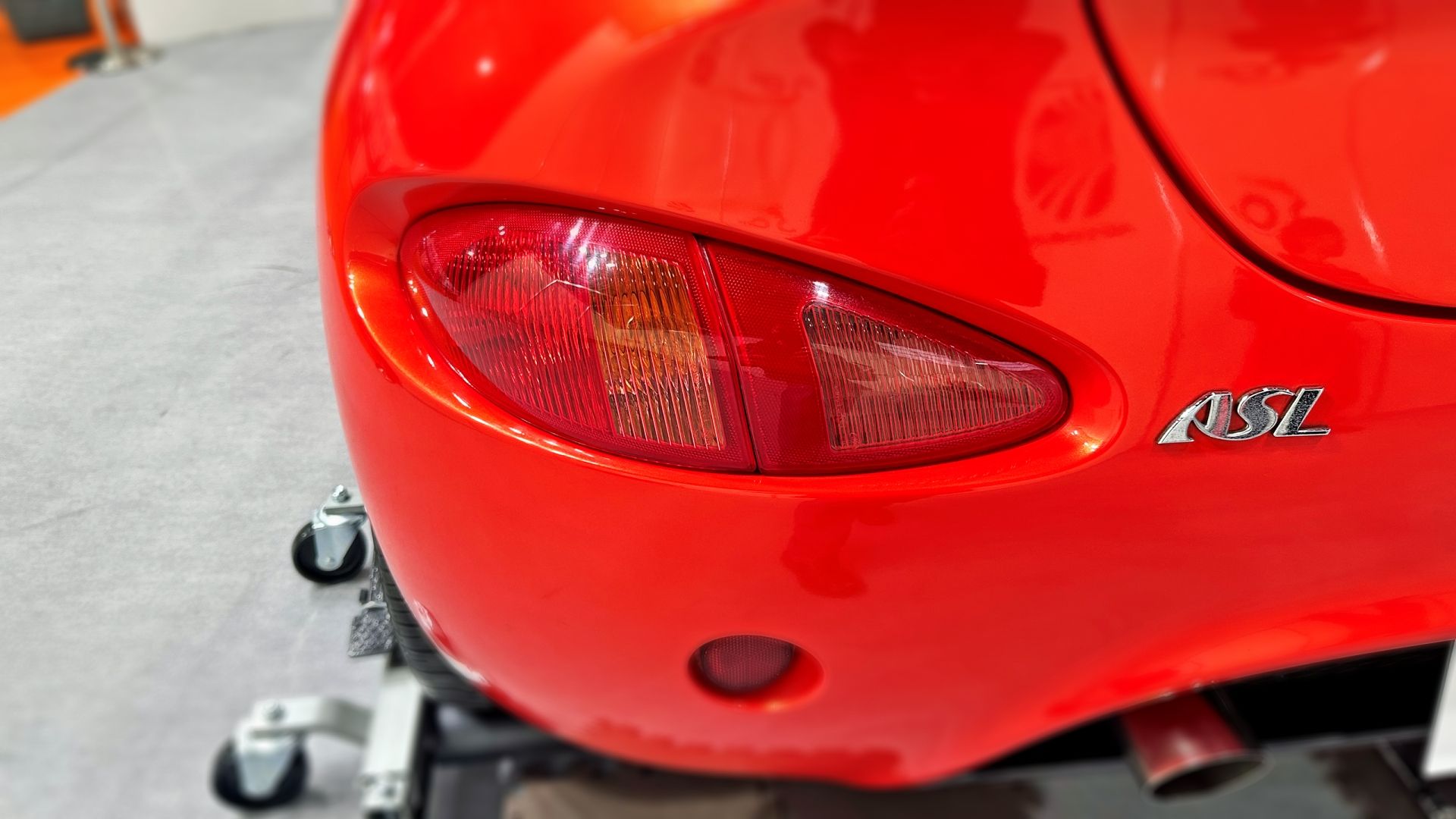
As for the rest of the Garaiya, its main objective was to be as light as possible. Building upon the Tommykiara ZZ’s tiny frame, engineers at ASL were able to keep the Garaiya’s weight down, while also increasing its size over the aforementioned ZZ sports car. Its shell was made entirely of aluminum, and it boasted a pair of scissor-type doors. Its sole transmission option was a six-speed manual and, interestingly, its taillights were borrowed from the Alfa Romeo 147.
We’ll lay out all known specs regarding the 2002 ASL Garaiya concept in the table down below:
|
Engine Details |
2.0L SR20VE NA inline-four |
|---|---|
|
Horsepower |
201 hp |
|
Torque |
152 lb-ft |
|
0-60 MPH Time |
5.2 seconds |
|
Top Speed |
137 mph |
|
Curb Weight |
1,750 lbs |
Features
Inside, the ASL Garaiya wasn’t a particularly well-equipped place to spend time. Keep in mind, the main purpose of the ASL Garaiya was lightness, and the usual creature comforts we have in our daily drivers, such as infotainment systems, comfy seats, and sound-deadening, are heavy, and so the Garaiya did without all of these. A pair of seats, a digital gauge cluster, and an HVAC fan were virtually the only features found within the Garaiya.
Why The Garaiya Never Went Into Production
Despite its positive public opinion upon its unveiling at the 2002 Tokyo Auto Salon, the ASL Garaiya never made it into mass production. Before the model’s production was ultimately canceled, ASL went as far as to set up a dedicated showroom to sell Garaiya models to the public. In total, roughly 60 orders for the model were placed following the showroom’s completion. But, many of these orders were thought to be purely speculative, with folks who had no intention of actually taking delivery of a Garaiya submitting orders just to see if the car would actually be produced.
Following two years of floundering over false orders, low capital, and general disorganization within ASL, the Garaiya model was canceled in 2005. By this time, a few finished prototypes had been produced, and rather than sell these off to the public, those completed models were given to senior members of the ASL company. In the end, fewer than 10 Garaiyas were produced, all of which were prototypes. Autobac’s motorsport side made a small name for the Garaiya in racing, as a Super GT-class version was produced that ultimately won seven out of 77 races in a career lasting from 2003 to 2012.
However, as for the road car, it melted into automotive obscurity, much like how a successful thief fades from public attention after a big score.
Sources: Supercars, RacingSportsCars