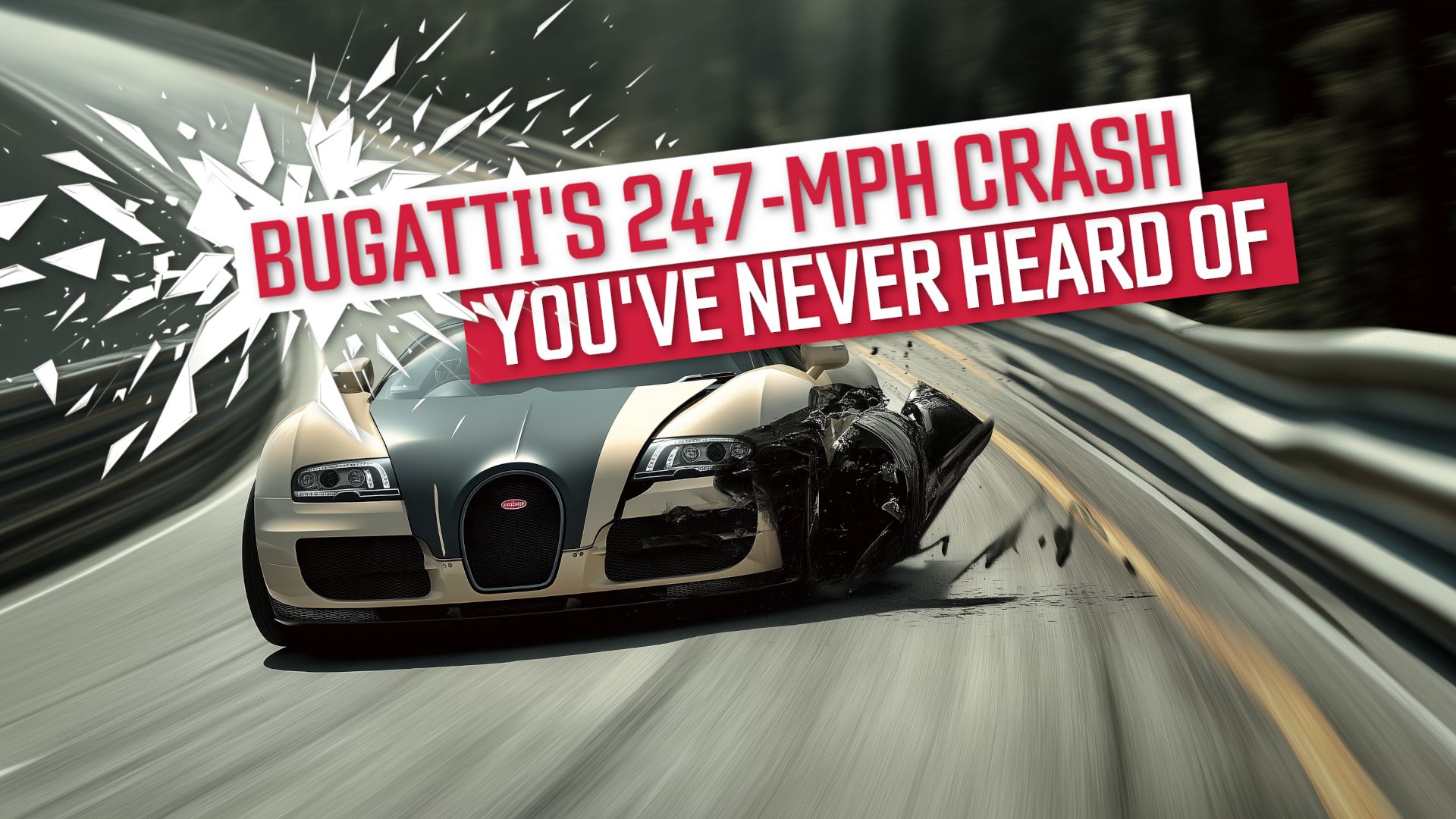
Bugatti’s 247-MPH Wipeout Proves Why Top Speed Records Don’t Happen On Banked Ovals
High-speed record attempts are exciting, showcasing a vehicle’s performance and a manufacturer’s engineering ability and testing the achievable boundaries. Several manufacturers are currently embroiled in attempts to surpass 300 mph, but one name stands proud above the rest as an icon of speed: Bugatti.
Related
Bugatti W16 Mistral Fulfils Top Speed Potential With 282 MPH Record Run
Bugatti’s last-ever W16-powered hypercar has just cemented the iconic engine’s legacy.
Since the early 1990s, Bugatti has set new standards for speed. The EB110 managed several of these, but it wasn’t until the Veyron surpassed 400 km/h (248 mph) with a 1,001-horsepower quad-turbo W16 engine that the automaker became the undisputed king of speed. Several automakers have gone faster since, and some of Bugatti’s records may have been disputed, but Bugatti will always have been the first, and it’s continued to set record after record since.

Bugatti
Bugatti was founded as an automaker by an Italian-born designer named Ettore Bugatti in Molsheim, Alsace, when the French city was a German one in 1909. Bugatti created several successful cars for road and racing, but Ettore’s death in 1947 led to the company ceasing operations in 1952 before a short-lived revival in 1963. The brand was revived again in 1987, resulting in the EB110 GT, but the company we know today only appeared in 1998, when Volkswagen Group acquired the brand. In 2005, the Veyron arrived, setting the tone for Bugatti’s contemporary era.
- Founded
- 1909 (Automobiles Ettore Bugatti)
- Founder
- Ettore Arco Isidoro Bugatti
- Headquarters
- Molsheim, France
- Owned By
- Porsche
- Current CEO
- Mate Rimac
But it recently emerged that Bugatti had lost access to the VW-owned Ehra Lessien test facility, which was a secret weapon in the manufacturer’s pursuit of top speed. Instead, it had to set a top speed record with the W16 Mistral at another facility in Germany. It prompted us to look into venues where records could be set. This led to finding out about the time Bugatti attempted a speed record at the Nardo Ring in Italy, resulting in a crash at nearly 250 mph – highlighting the dangers of attempting speed records on anything but arrow-straight and perfectly level test areas.
This article’s information about Loris Bicocchi’s crash was sourced from a recorded interview from 2017. Information is accurate at the time of writing, and relies on unofficial sources, as Bugatti has not published information on the incident.
The 247-MPH Veyron Crash Bugatti Doesn’t Talk About

The Veyron is famous for being the first production car to break the 400 km/h (248 mph) mark, doing so on 29 April 2005. But that didn’t happen without extensive testing, and in one such test, things took a turn for the worse. At the Nardo Ring, Bugatti test drive Loris Bicocchi drove a Veyron prototype up to a speed of 247 mph (398 km/h) around the banked test facility. But before he could reach 400 km/h, a tire exploded, resulting in a terrifying high-speed crash that damaged 1,969 yards worth of guardrail at the facility. Remarkably, Bicocchi escaped with only minor injuries.

Add CarBuzz to your Google News feed.
Bugatti never divulged the details of this incident publicly, but in 2017, Bicocchi conducted an interview with Italian journalist Davide Cironi in which he explained what happened.

Loris Bicocchi
Loris Bicocchi is an Italian racing driver and vehicle test and development driver who began his automotive career working in a warehouse for Lamborghini before becoming a test driver. His most notable achievements came during the development of the Bugatti EB110 and later, the Veyron. Bicocchi has been involved in the development of numerous supercars and hypercars, including the Pagani Zonda, Lamborghini Countach, Koenigsegg CC8S, and Bugatti Chiron.
A High-Speed Blowout At 247 MPH
Bicocchi recalls the test one Sunday in 2002 or 2003. The day of testing started out like any other, doing moderate-to-high speeds to test whether the heat exchangers, oil exchangers, and water temperatures behaved at the high speeds the Veyron was targeting. It was, as Bicocchi calls it, “routine.”
“And then they told me, ‘Can you do a flat-out lap?'” Bicocchi recalls. He did as he was asked, completing a full lap of the 7.8-mile loop with his foot pinned to the floor, and after he’d done one lap at speeds nearing 250 mph, he was asked if he could do two in a row in the same clockwise direction, with engineers noting temperatures were still rising, they wanted to see where those temps would plateau. “I said, ‘Two laps are a lot, but we can try. Let’s do two flat-out laps.'” But at the end of the second lap, things went pear-shaped. Bicocchi notes that throughout the two laps, the speeds he was achieving were fluctuating between 390-398 km/h, with the engine revs rising and dipping by about 100 rpm as the track surface undulated beneath him.
“At the end of the 2nd flat-out lap, which is something crazy […] suddenly, out of the blue I heard like a little [whining noise] and then BOOM. I couldn’t see anything. A few moments before the zero kilometer, the front left tire exploded, taking the fender with it. […] When the tire blew, I was a foot away from the guardrail […] In a snap, I didn’t even realize it, I hit the guardrail. The first hit made the rear left tire blow too. […] The suspension broke because I hit the guardrail [so] hard.”
– Loris Bicocchi, former Bugatti test driver
With two tires blown and broken suspension, it should come as no surprise that other systems failed, too. Bicocchi claims he tried to brake, but the pedal didn’t work – hypothesizing that the hoses broke when the suspension failed – so he turned into the guardrail, using friction to slow the Veyron down. Fortunately, it worked, but in the process, more than 5,900 feet of guardrail were damaged and needed replacing. Bicocchi was invoiced for the repairs by the Nardo Ring, with Bugatti footing the bill.
He did this all blind, too, as he recalls how the blow-out damaged the bodywork and impeded his view through the windshield. “The fender raised and brought the hood with it, smashing the windscreen,” explains Bicocchi.
“I had a veil in front of me made by the fender – I still remember it was beige, the hood was black – the glass shattered in a billion pieces, and I was doing 395-398 (km/h), in the luckiest case, 390.”
Once the wreckage had been brought to a halt, various fluids like oil started to smoke, the fumes filling the cabin through the holes in the firewall engineers had used to wire in various bits of test equipment. Bicocchi fought his way out, after which he said he remembered nothing. But he remarks that he was surprised at how well the car’s structure sustained such an impact. Bicocchi was bruised, and his helmet had impacted the side window, shattering it in the process, but other than that, he was OK.
Bicocchi doesn’t level blame for the incident wholly on any party, but a few of his observations show why a venue like the Nardo Ring may be great for high-speed testing but has limits that shouldn’t be pushed beyond.
The Nardò Ring And Its No-Steer Banking

The incident discussed above took place at the Pista di Nardò test track in Southern Italy, famously known as the Nardo Ring. The track is configured as a long oval with a length of 7.8 miles, famously known for its banking that allows you to travel at certain speeds without needing to steer. The circuit is four lanes wide with no straights, and each of the four lanes is increasingly banked, with the outer lane being the steepest at an angle of 12 degrees, Because of this, each lane has a ‘neutral speed’ at which you can travel straight without needing to turn the steering wheel:
- Lane 1 – 62 mph/100 km/h
- Lane 2 – 87 mph/140 km/h
- Lane 3 – 118 mph/190 km/h
- Lane 4 – 149 mph/240km/h
Typically, speeds beyond 149 mph are not allowed in regular testing, although they have been exceeded with special permissions, like when the Koenigsegg CCR reached a 240-mph top speed there in 2005. At the time of the Bugatti incident, the Nardo Ring was owned by Fiat, but it is now owned by Porsche.

Related
The Bugatti Tourbillon Almost Had Koenigsegg’s Wildest Technology
Mate Rimac says he and Christian von Koenigsegg discussed Tourbillon development long ago, and they almost collaborated on the new hypercar.

The Problems With High-Speed Testing On Banked Circuits
But while you may be able to travel in a straight line, the nature of a banked circuit and the centrifugal forces it exerts on a vehicle mean that greater forces are exerted on the outside tires of a vehicle, with these only increasing as the speeds do.
As Bicocchi noted, “You know that the Nardò track is balanced until 240 km/h. After that, you start to turn, and turn, and turn… At 360 km/h you have to withstand a 0.3-0.35 g force, an important value. It’s not that healthy to keep the car like that for 12 kilometers.” The constant load on the outer tires also results in uneven temperatures from left to right.
“It’s also something the tires don’t want because you’ve got a weight transfer, from the inside to the outside due to the body roll […] so the temperatures rise.”
Even when driving in a straight line at speeds of 248 mph+, tires are put under immense forces that weaken their inner structures. When you factor additional side-to-side load into it, banked tracks threaten to prematurely deteriorate a tire, adding to the risk factor of a high-speed record attempt.
For reference, during Bugatti’s most recent record with the W16 Mistral, Michelin insisted on changing tires every few miles. According to the Top Gear Magazine podcast, the Michelin tires Bugatti uses can only be driven at speeds of 250 mph for 6 miles before needing to be replaced, even if they look in fair condition to the human eye.
Another element to consider is the so-called circle of grip (also called a friction circle or traction circle). A tire has a maximum level of gripping force, and when you try to mix linear and lateral grip, you reduce its ability to adhere to the road as well as it can in either direction. That means you can’t rely on that tire to grip as well when doing high speeds in a circle, again, increasing the risk factor.
Banked circuits enable us to achieve high speeds without needing extensively long straight roads, but they aren’t perfect, and their unique make-up results in compromises, or rather limitations, to what can be achieved.
The Perfect Setup For Top Speed Records

So, if circular, banked tracks are only good for limited testing up to a certain speed, then what’s the ideal road or track for setting new top speed records? In theory, a dead straight road (and with no incline or decline), multiple lanes wide, with fencing to keep animals out and barriers to block wind is the ideal setting. But the problem is that at the speeds modern hypercars are capable of, you need roads that are dozens of miles long to get up to speed without having to accelerate too viciously and then slow down again in the safest fashion possible.
When we spoke to Hennessey founder and CEO, John Hennessey, earlier this year, he told us the Venom F5 could theoretically reach 328 mph, but “to hit that, I might need six or seven miles.” Where on earth would you find a road that long that meets all the criteria mentioned above? “We’re likely to have to do our V-max run on a runway which, at NASA, is only 3.2 miles long, so you can only accelerate for maybe two and a half miles, and you need that last seven-tenths [of a mile] to slow down.”
Combining Banking With Straights
So, instead, combining the best of a banked circuit and a straight road is the best we can do. Hennessey referred to the VW Ehra Lessien test facility Bugatti previously had access to as being the ideal place for top speed records. That’s because the banking allows you to get up to speeds of 124 mph or more before you even reach the straight, after which you can punch it, hit top speed, and then slow down to the speed for the next bit of banking several miles down the road.
Ehra Lessien isn’t the only test facility in the world with this sort of configuration, but it is the one with the longest straight – measuring more than five miles long. ATP Automotive Testing Papenburg has a similar setup to Ehra Lessien, but its straights are only 2.48 miles long (4 km). Outside of Ehra Lessien, it seems to be the next best place for such attempts to be hosted, which is why Bugatti took the W16 Mistral there and why it was also the site at which the Chevrolet Corvette ZR1 set an immense top speed of 233 mph earlier this year.
Sources:
Bugatti, Porsche,
Top Gear Magazine
,
Automotive Testing Papenburg