10 Interesting Cars Cancelled At The Last Minute
With well over 100 years of automotive history in books, a lot of cars have come and gone, and some models have gone on to become icons. Standouts, like Porsche 911, Ford Mustang, and Chevy Corvette, to name a few, while others have landed square on their faces (we’re looking at you, Pontiac Aztek). But many more never reached the market at all, with some being canceled right before their big reveal.
Below is a list of 10 vehicles that had the rug pulled out from underneath them before they could show what they were capable of. Cars get canned for plenty of reasons, like changing market dynamics, financial concerns, or strategic shifts, but other times they’re canceled just because they’re not very good. So, no, not every vehicle on this list deserves your compassion, but it’s still best to remember what could have been had history transpired just a bit differently.
10 Porsche-Studebaker Type 542
In the early 1950s, Studebaker was in a bad spot for many reasons and needed a fresh new model to spur sales. Porsche was looking to expand its influence, and although there are a few competing stories regarding how the two got together, they eventually partnered to create a luxury sedan that blended Porsche’s engineering with Studebaker’s American design. The Type 542 was designed with both air-cooled and water-cooled engine options, aiming to offer a unique rear-engine layout.
It was essentially a 356 with four seats, and the project gained momentum, promising a high-performance vehicle appealing to both the American and European markets. Unfortunately, Studebaker’s financial situation went from bad to worse, making it clear they could not continue development, only taking a look at the model once it merged with Packard. By then, a few years had passed, and allegedly, John DeLorean, an executive at the company at the time, passed on it because it was too dated by that point. Ultimately, the Type 542 was canceled, with only a few prototypes surviving as a testament to what could have been.

Add CarBuzz to your Google News feed.
9 Jaguar C-X75
The Jaguar C-X75 was an ambitious hybrid supercar unveiled in 2010 that just about everyone wanted to see make it to production. It featured a 1.6-liter turbocharged and supercharged engine paired with electric motors good for nearly 900 horsepower and a top speed exceeding 200 mph. It was designed to blend high-performance engineering with environmental responsibility, not to mention it was downright gorgeous and ferocious, just as a supercar Jag should be.
Unfortunately, the project faced significant challenges, the biggest of which was the world economy still reeling from the Great Recession. The high costs associated with bringing advanced technology to market for such a small brand, combined with doubts about its sales potential, led to the project’s cancelation in 2012. Only five prototypes were built, with one being driven by Dave Bautista in the James Bond Spectre film, but ultimately nothing came out of it except some design inspiration for future models like the Jaguar I-Pace. It’s one of the biggest misses in recent memory, in many people’s eyes.
8 BMW i16
When the BMW XM was revealed, the world was disappointed because it wasn’t the M1 successor we were all hoping for. Well, it turns out the brand did consider a more conventional successor before switching gears, and sometimes it really is better to live in ignorance rather than know the truth. As part of BMW’s innovative i sub-brand, the i16 was intended to be a smaller, sportier counterpart to the i3 and i8. The i16 was envisioned as a compact, all-electric vehicle catering to urban drivers who wanted practicality and BMW’s signature driving dynamics.
However, as market analysis favored larger vehicles like SUVs and crossovers, the case for a small, sporty electric car became less compelling for the world entering a pandemic in 2020. Internal debates about resource allocation led to the i16 being shelved, with BMW focusing on electrifying its more popular and profitable models. The decision left a gap in the market for those who anticipated a smaller, performance-oriented EV from BMW, and has us wondering what else could have been different if the pandemic hadn’t disrupted everything.
7 Ford Probe As The Mustang
This one is less about a canceled model and more about a terrible decision that was ultimately averted. In the early 1980s, Ford considered a radical shift by replacing the Mustang with a front-wheel-drive vehicle developed with Mazda, of which it owned a decent chunk. The Ford Probe was conceived as this replacement, with a modern, aerodynamic design appealing to younger, more fuel-conscious buyers. The Probe was intended to embody the future of Ford’s performance cars, moving away from the traditional muscle car image. However, when news of replacing the Mustang with the Probe became public, it sparked a massive outcry from Mustang enthusiasts.
When news broke of the switch before the reveal, thousands of letters poured into Ford corporate begging for the brand not to ruin such an iconic model. Recognizing the strength of the Mustang brand and the loyalty of its fanbase, Ford decided to maintain the RWD, V8 Mustang as we have always known. The Probe did turn out to be a good car and ended up building a fanbase of its own, but nothing like the storied Mustang.
6 Nissan Mid4

The Nissan Mid4 was an ambitious concept introduced in the mid-1980s that looked to compete against models like the Honda (Acura in the U.S.) NSX. The Mid4 featured a mid-engine layout, all-wheel drive, and four-wheel steering – technologies that were groundbreaking at the time. Nissan intended the Mid4 to serve as a halo car and two prototypes were built, with the second iteration, the Mid4-II, boasting even more advanced features, including a twin-turbocharged V6 engine.
As you can imagine, it received universal acclaim, with journalists praising its handling and performance. As development continued, however, Nissan began to question the car’s potential profitability (shocker) given the tanking of the Japanese economy. The Mid4 was projected to be expensive to produce, and its market positioning was uncertain. Ultimately, Nissan decided to cancel the project, but the technologies developed for the Mid4 were later incorporated into other Nissan models, most notably the Nissan GT-R.
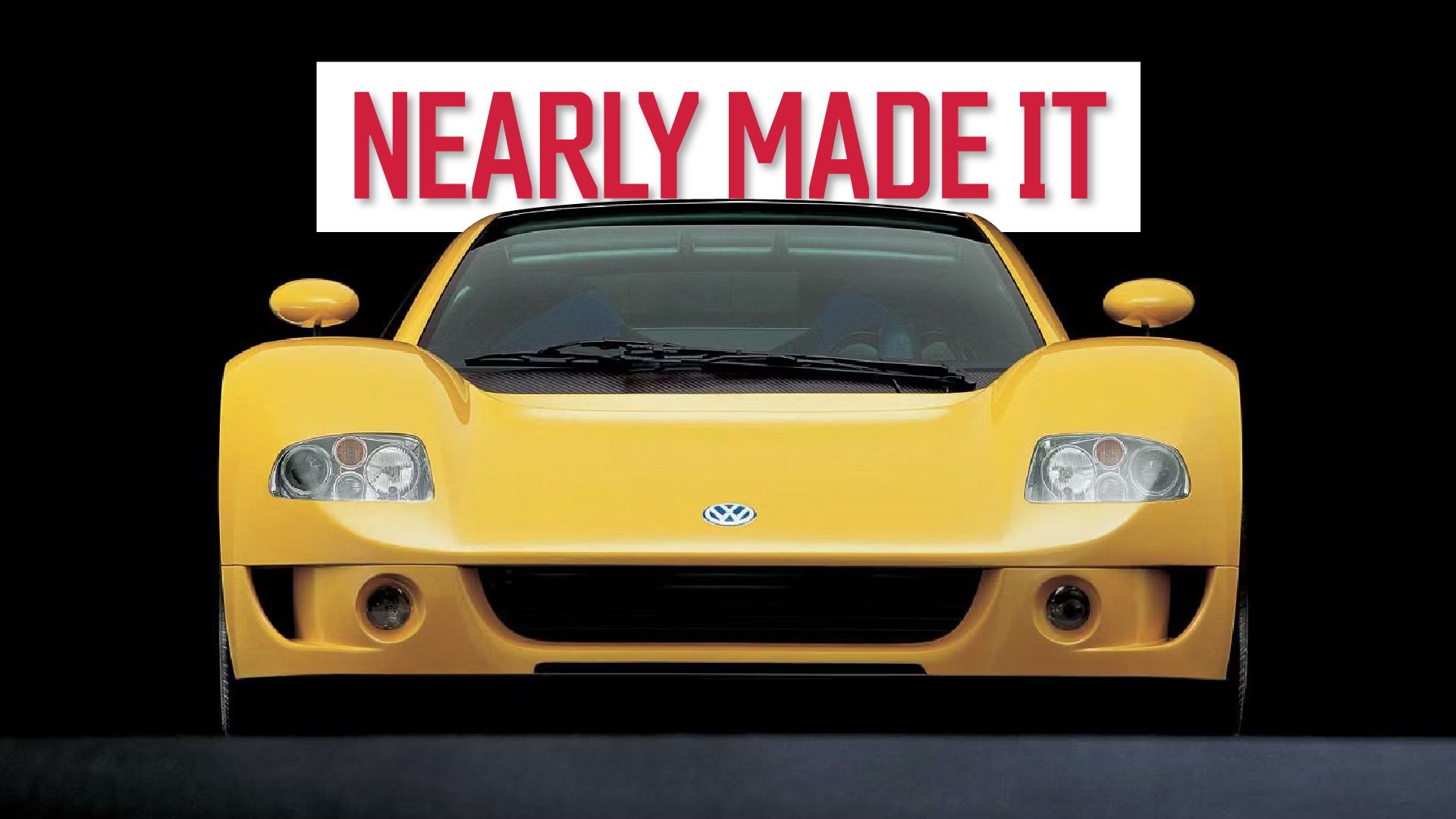
5 Volkswagen W12
The Volkswagen W12 is what you get when your CEO has insane ambitions. The car featured a unique W12 engine, essentially two narrow-angle V6 engines combined to form a compact yet powerful 12-cylinder unit. This engine design allowed for impressive power output while maintaining a relatively small footprint, making it ideal for a high-performance sports car, and CEO Piech wanted to create something that was going to wow the world. When it was introduced in 1997, it did just that, setting speed records along the way.
The world was smitten, and buyers were lining up to get their names on the list. It was around this time that Volkswagen acquired luxury brands like Bentley and Bugatti, and the focus shifted away from producing a supercar under the Volkswagen nameplate. The engineering knowledge gained from the W12 project was instead applied to these luxury brands, leading to the development of models like the Bugatti Veyron and Bentley Continental GT, both of which utilized similar W-engine configurations. The concept never made it to production, unfortunately.
4 Electric Jaguar XJ

This is probably the most recent cancelation, and we still don’t know how beat up we are about it. The Electric XJ was intended to be a key pillar in Jaguar’s transition to a fully electrified lineup, positioned to compete with luxury EVs like the Mercedes EQS and Porsche Taycan. The project represented a bold step forward, combining the timeless elegance of the Jaguar XJ with cutting-edge electric technology, and seemed like a no-brainer to most outside sources, but apparently not the then recently installed CEO Thierry Bollore.
Prototypes were built and tested, and early reports indicated the car would offer the same levels of comfort and sophistication as its predecessors, but Thierry took one look and realized the brand wasn’t pushing the model far enough. He canned the model as part of the brand’s broader “Reimagine” strategy, refocusing Jaguar on developing a new generation of luxury EVs. This meant the XJ was dead, for now, and now we wait for December when the brand is set to debut a new four-door GT that is going to spearhead Jaguar’s future.
3 Pontiac G8 ST
Have you ever dreamed about GM reviving models like the El Camino? Well, in the late 2000s, it almost happened, and it was going to be glorious. Based on the Australian Holden Ute, the G8 ST was essentially a two-door, car-based pickup that promised to deliver both utility and driving excitement, and it was coming to the US thanks to passionate executives like Pontiac Head Bob Lutz. The G8 ST was going to offer all the performance of the G8 with practicality to match.
The model was poised to bring a new dimension to Pontiac’s lineup, but unfortunately, the Great Recession took no prisoners. Given the precarious financial situation of General Motors in 2008, the company was forced to discontinue the Pontiac brand as part of restructuring efforts. With the closure of Pontiac, the G8 ST project was dead in the water. It remains one of the last intriguing vehicles Pontiac almost brought to market and the fact we never even got it as an SS model shows just how far GM has fallen.
2 Toyota GT86 Convertible
In the grand scheme of missed opportunities, this feels like a glaring one. When the Toyota GR86 / Subaru BRZ twins debuted, they quickly became fan favorites for their nimble handling and budget performance. To build on this success, Toyota planned to introduce a convertible version of the GT86, offering the same exhilarating driving experience with the added thrill of open-top motoring. The GT86 Convertible was showcased as a near-production concept at various auto shows as the Toyota FT-86 Open concept, generating significant buzz and anticipation.
We were excited about the prospect of Toyota releasing a cheap convertible again, but the niche appeal of the car, combined with the costs associated with bringing it into production, led Toyota to reconsider its plans. Ultimately, the project was canceled, with Toyota choosing to focus on updating the GT86 coupe and developing new models that would appeal to a broader audience. This may be why we received models like the GR Corolla, but it still hurts to think of what we could have had.
1 Porsche 989

The Porsche 989 was a bold attempt by Porsche in the late 1980s to change its tanking fortunes with a four-door luxury sedan. The company was in a rut with an aging, expensive lineup, and it needed to reach new customers. The car was designed to compete with luxury sedans like the Mercedes-Benz S-Class and BMW 7 Series but with a distinctly Porsche character, featuring a front-engine layout, with a new V8 engine designed specifically for the car.
It was sleek, with design elements that would later influence the following Porsche 911, and a working prototype of the 989 was built with plans for sale. As executives examined the project, however, they realized this wasn’t the right model at the time, as it was too expensive to build and sell. The project was ultimately deemed too risky, and Porsche decided to cancel the 989 in 1991, focusing instead on its core sports car lineup and adding another car to their list of models that didn’t quite make it. The Boxster and Cayenne would later be the saviors of the brand, and the sedan dream was realized with the eventual debut of the Panamera.