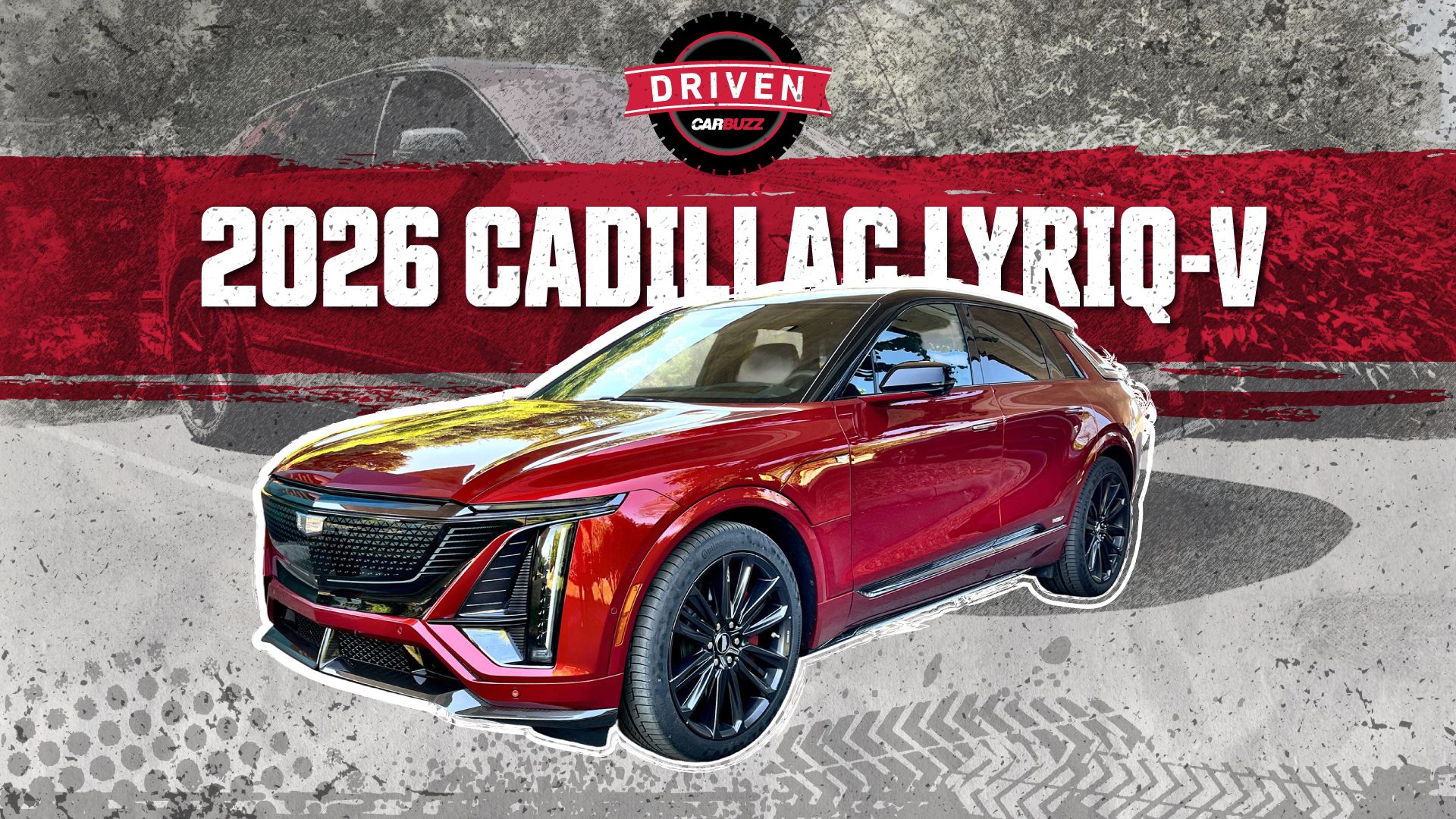
An Electric Caddy With True V-Power
Now that Cadillac has established the vast majority of its expansive EV line-up, it’s now able to focus on offering specialty versions. First up is the Lyriq-V, and it immediately gets attention for its performance numbers. It offers 615 horsepower and 650 pound-feet of torque – specifications only matched by some of the hottest and most expensive electric models from the competition.

- Base Trim Engine
-
dual-motor Electric
- Base Trim Transmission
-
Single-speed Automatic
- Base Trim Drivetrain
-
All-Wheel Drive
- Enormous power and solid handling
- Classy styling inside and out
- Value packed
- Could be sportier to drive and look at
- Seats are a little disappointing
Numbers aren’t everything though, so we had to try it out for ourselves. Cadillac flew us out to Seattle to get up close and personal with the hot electric SUV. What we discovered was a seriously capable machine with a stacked feature list and a seriously attractive price tag (for the segment).
First Drive events provide our initial impressions of a vehicle in a restricted environment under certain time constraints. Keep an eye on CarBuzz for our comprehensive Test Drive review which will follow soon.
What Is It?
The Cadillac Lyriq-V is the hot version of the Lyriq electric SUV. It features more powerful motors, sportier suspension, and stronger brakes to ensure it can go like a Cadillac V model should. Also, while the Lyriq-V does have some visual changes, they’re extremely restrained in comparison to the dramatic increase in performance.
Exterior Looks: Speaks Softly
|
Strengths |
Weaknesses |
|---|---|
|
|
|
Surprisingly, there’s not much to talk about with the Lyriq-V’s appearance. The lower grille and spoiler at the front have been slightly redesigned, the rocker panels and wheel arches are paint matched, V badges are affixed on all sides, and 22-inch wheels are fitted. It also gets a black-painted roof, and carbon fiber trim for the front and rear spoilers and rear diffuser area are optional. That’s really it.
Fortunately, the Lyriq is a stylish-looking car to begin with, so it still looks good. The carbon fiber trim is as subtle as anything else, too, making it the right amount of garnish on the car. However, the Lyriq-V is clearly not for peacocks, since only those in the know will recognize that it’s something special.
Interior: Are You Sure This Is The ‘V’?
|
Strengths |
Weaknesses |
|---|---|
|
|
|
While it’s tough to spot the Lyriq-V’s exterior changes, it’s even harder to do so with the interior. The steering wheel has a slightly different rim, and the touch-sensitive buttons now include a “V” button for accessing drive modes. On the back side of the wheel is the paddle for activating full regenerative braking, and it’s now made of aluminum. The seats have power-adjustable bolsters, and the door sills are illuminated and feature the V branding.
Jumping up to the Premium trim adds Nappa leather quilted upholstery with some V logos added. Otherwise, the interior looks nearly identical to a regular Lyriq. That’s not a bad thing, though. It’s as clean and elegant as ever, with the trapezoidal instrument and infotainment screens nestled in the dash. Leather is found throughout, and the trim is made of recycled paper, something that’s popping up in other luxury cars, too.

Related
REVEALED: 2026 Cadillac Lyriq-V Is The Quickest Caddy Yet
Cadillac is giving the Lyriq the V treatment with impressive performance and unique style.
Where the Lyriq-V stands out is in the number of included features. The front and rear seats and steering wheel all feature heating, and the front seats have cooling and massage functions. It gets the 23-speaker AKG sound system, three-zone automatic climate control, augmented reality head-up display, and, of course, Super Cruise. Basically, the Lyriq-V is as fully loaded as a Lyriq can get.
Our one disappointment with the V’s interior, though, is with the front seats. Despite having adjustable bolsters, they simply don’t provide much in the way of lateral support. They’re also fairly flat, even with adjustment for lumbar. We wouldn’t call them a dealbreaker, but Cadillac really should up its game when most of its competitors have far superior chairs. On the plus side, the rear seats are roomy and comfortable, something not everything in the sporty luxury EV space can claim (we’re looking at you BMW i4).
Infotainment: A Look At What GM Infotainment Could Be
Cadillac’s 33 inches of screen space for instruments and infotainment is stylish, bright, and crisp. The instrument panel can be a little tricky to see behind the steering wheel, but is generally useful and can display all kinds of information, including maps. The head-up display is welcome as always, and the augmented reality function for helping show when to turn is appreciated, but it’s not as good as, say, the system in Mercedes products. The Cadillac system mostly just shifts the turn arrows from looking like they’re far away, or close up. The Mercedes system has more animation and can move more, making it easier to gauge where a turn is.

The main infotainment system is responsive, has large icons, and it’s easy to set up useful shortcuts. We also like the physical climate control shortcuts and volume knob. We just wish Cadillac had physical buttons on all of the steering wheel controls, too. Cadillac even still features a control knob if you don’t want to use the touchscreen. Also, shockingly, it seems Apple CarPlay and Android Auto are still included on the 2026 Lyriq, fixing our biggest complaint with the otherwise solid infotainment systems GM has put in its EVs.

Powertrain & Driving: Carries Two Huge Motors
|
Strengths |
Weaknesses |
|---|---|
|
|
|
The centerpiece of the Lyriq-V is, of course, its beefy electric motors. They’re the same as what you get in the Blazer EV SS, and in the Velocity Max mode, they produce the same combined 615 hp and 650 lb-ft of torque. Also, like the Chevy, once Velocity Max is on (activated by a long press of the V button on the steering wheel, or when Competition Mode is activated), the Lyriq-V is always making the full 615 horsepower. It doesn’t shut off after a short period of time, though it does switch off when the car is shut down. So you’ll have to reactivate it on restart.
2026 Cadillac Lyriq-V
|
|
|
Engine |
Dual-motor |
|
Transmission |
Single-speed |
|
Drivetrain |
AWD |
|
Power |
615 hp |
|
Torque |
650 lb-ft |
|
0-60 |
3.3 sec. |
|
Top Speed |
130 mph |
Similarly, the Launch Control, which can be accessed in Velocity Max at any time by pushing hard on the brake at a stop, has no limit on number of launches. So it can race to 60 mph in the claimed 3.3 seconds over and over and over and over again. We’re certainly inclined to believe the number, since it pins you to the seat with authority, and keeps pinning you all the way through the 60 mph mark and beyond. Cadillac also claims that it will do the quarter-mile in under 12 seconds, though it won’t have much left past the quarter-mile due to its 130-mph top speed.

Related
Cadillac Lyriq Gets Another Recall For The Silliest Reason
Even the Cadillac Lyriq manual needs fixing; GM issues its sixth recall for the EV.
We should also quickly touch on Competition Mode. It can be activated in the sportiest setting, V Mode, and it allows for more tire slip from the traction and stability control systems. It also makes the brake-based torque vectoring more pronounced for the rear motor, and it changes how front motor power is applied. With more steering lock, it will limit the amount of front motor power to reduce understeer. And while we’re on drive modes, the Lyriq-V has a standard Tour mode, which is the comfortable and balanced setting, and progressively sportier modes including Sport and V. A “My Mode” allows for a mix of settings for steering, suspension, throttle, and even brake feel, and V Mode has those adjustments, too.
The Magic Is In The Upgraded Mechanics
Making all of this possible are a number of other upgrades, besides motors with more power. The final drive ratios for each motor’s single-speed transmission have shortened, with the front motor switched to 11.6:1 at the rear (versus 10.5:1 on a regular Lyriq) and 11.59:1 at the front (versus 9.86). The rear halfshafts are thicker, and the cooling system has been upgraded from the 2025 Lyriq line. This system will actually show up in all Lyriqs for 2026, but the V gets revised programming for how it uses the system. So, in the sportier modes, it will be more proactive about keeping heat down to ensure maximum performance. Related to that, one-pedal driving is not available in the Competition Mode. According to an engineer, a key reason for this is related to cooling. Regenerative braking puts heat into the motors and cooling system, and limiting the regenerative braking to activating only on the brake pedal helps to avoid heatsoaking the motors and cooling system, and thus avoiding any power reduction.
That brings us to the Lyriq-V’s braking and handling upgrades. It gets six-piston Brembo front brake calipers, and Cadillac offers two different combinations of pads and rotors. As standard, Cadillac fits ferritic nitrocarburizing (FNC) rotors and “non-asbestos organic lining” pads. As a no-cost option, buyers can opt for non-FNC rotors and “low-metallic lining” pads, which will produce more dust, but offer better overall performance. Similarly, Cadillac also offers either standard summer tires, or optional all-seasons.
The suspension and chassis see the biggest changes, though. The steering rack has a quicker ratio, and the suspension has stiffer springs and anti-roll bars – the latter being way stiffer. The rear bar is more than 500% stiffer than that of a standard Lyriq. Stiffer bushings and subframe mounts have also been fitted, and the Lyriq gets shocks to match: a set of Sachs Continuous Damping Control shocks. These are electronically adaptive shocks, and the V is the only Lyriq to get them. This also helps set the Lyriq-V apart from its Blazer EV SS cousin, which makes do with fixed shocks.
We asked a Cadillac engineer why they didn’t use Magnetic Ride Control like GM has used on many performance vehicles in the past. He told us that they felt the Continuous Damping Control shocks were a better fit considering the Lyriq-V’s heavy curb weight. Indeed, these shocks also appear on some of GM’s full-size trucks such as the GMC Sierra Denali. The Lyriq-V is also quite heavy at 5,980 pounds. At the same time, Ford features magnetic shocks in the Mustang Mach-E GT, and Cadillac itself offers them on the full-size Escalade, so there may have been some other factors at play, too. Cost might’ve been a factor, and Cadillac may also be leaving a little bit of room for something even more impressive, like a Lyriq-V Blackwing – but this is just speculation.
From Behind The Wheel

To see how all these upgrades come together, we spent a couple mornings driving around Seattle on city streets, highways, backroads, and even a small autocross course. The autocross course revealed fairly quickly that, although extremely fast off the line, the Lyriq-V is no track vehicle, but Cadillac doesn’t claim that it is. The enormous weight makes it easy to blow past the front end’s limits if you don’t slow it down enough, and once that’s gone, all you’ll get is understeer. So getting the most out of it means hauling it down well before the turn, which those Brembos do quite well, as well as being very judicious with the throttle to not lose the front end, even with the Competitive Mode activated.
Follow those rules, though, and the Lyriq-V can feel nicely balanced and stable. Rather than something like a Kia EV6 GT or Hyundai Ioniq 5 N, which are more sporting and oversteer-y machines, the Lyriq-V is clearly tuned to have more moderate handling limits with safe understeer so as not to get owners into trouble. That’s great, though we are left hoping for a Blackwing that could match the huge power with handling to match.

On public roads, the Lyriq-V came into its own. With the constraints of traffic and laws, the car can feel rather fun on back roads. The steering is far more precise and even has a surprisingly amount of feel compared with the Blazer EV SS or even the sharp but numb BMW i4 M50. The sweet spot for the car is definitely the Tour mode, though. The suspension in Sport and V modes can be harsh on bumps, and the reduction in body roll isn’t particularly dramatic. The softer Tour mode is much more comfortable, though neither setting feels quite as controlled as the aforementioned BMW. The Tour steering setting is also a sweet spot, as it communicates about as well as the Sport setting, but without feeling like you have no assist at all (seriously, the Sport steering is heavy). So on the street, leave it in Tour, hold the V button for Velocity Max and all its power, and let the Lyriq-V do its thing: serene cruising and commuting during the week, and whipping through windy roads with poise on the weekend.
1:00

Related
Video: An All-New Cadillac XT5 Already Exists Outside Of The US
Although GM hasn’t confirmed whether the XT5 will be replaced stateside, an all-new model already exists elsehwhere in the world.
Efficiency And Charging Details
The Lyriq-V, while a performance luxury car, is still an electric car, and so range and charging specs are important. The battery pack has 102 kWh of capacity, and GM’s early estimate for range is 285 miles. That’s a notable decrease over the Blazer EV SS, which offers just a smidgen more than 300 miles of range, but it just tops the BMW iX M60’s 284 miles, and has a solid lead over the i4 M50’s 267 miles. As for charging, the Lyriq-V supports DC fast charging, though Cadillac doesn’t give a peak number for charge rate. The company does estimate that the car will reach an 80% charge in about 41 minutes, and it can add up to 75 miles of range in about 10 minutes. Additionally, the peak AC charging rate for the Lyriq-V is 11.5 kW, but upgrading to the Premium trim gets you an upgraded charger that peaks at 19.2 kW.
Verdict & Pricing: Putting The “Grand” In Grand Tourer
The Lyriq-V is available in either a base trim or the Premium trim. The base model has an MSRP of $78,595, or $80,090 with the $1,490 destination charge added. That’s about $8,000 more than a top-spec Lyriq Sport 3. The Lyriq-V Premium starts at $83,795 ($85,290 including destination). The Premium mainly gets nicer upholstery, as well as an opening panoramic sunroof and faster AC charger. Neither of those prices are particularly affordable, but they compare well with the German competition. To get a BMW iX that even comes close to the power and acceleration of the Lyriq-V, you’ll be spending more than six figures on the M70. The xDrive60 is closer in price at a bit more than $88,000, but only offers 536 hp and won’t get to 60 mph any quicker than 4.4 seconds. The situation is similar at Mercedes-Benz, where the 617-hp AMG EQE is comfortably in the six-figure range, with the next-quickest model, the EQE 500, offering just 402 hp, a 0 to 60 time of 4.7 seconds, and a price tag flirting with $90,000.
The Lyriq-V isn’t perfect. It’s a bit heavy, a bit modest, and the suspension could maybe use a little more fine-tuning. However, it’s not hard to forgive those minor flaws when it’s still intensely quick, rewarding within its limits, and still looks beautiful. With its lengthy features list and price that the competition can’t touch, it’s a must-see for anyone looking at powerful, plush EVs.